

Code like a boy...
Building blocks of connection

As a child were you coded to think in certain ways due to the toys and games available to you?
A number of the toys I had revolved around engineering, they taunted my imagination and mocked my grasp of reading intricate exploded diagrams.
Meccano was surely the inspiration for Swiss Flat Pack furniture - on the box it showed me I would be able to build helicopters, race cars and tractors all from the same kit…. reality was all those fiddly bolts that never got tight enough in awkward spaces, made me wonder if this was supposed to be play why did it not feel like fun… naturally I bought a set for my boys later in life and they hated it as well.
Wooden blocks were pretty good as they had no instructions but beyond building jenga towers and clumsy domino rows I wasn’t quite sure what else to do with them.
Lego was pretty pricey so we didn’t suffer much of that underfoot… I could build a basic house but beyond that my imagination didn’t match the marketing vision.
Most of the board games we owned seemed to be gladiatorial in nature - monopoly, chess, checkers all pitted individuals against each other. The common theme in the boys toys and games I grew up on were their focus on the individual - solitary activities that were more like problems to solve or ways to trip or trap the other player… who in most cases was my older brother who as a young person was not emotionally equipped to deal with the opposite of winning.
Personally I enjoyed reading the most as a kid and would come home with armfuls of books and escape into other people’s imaginations. While reading is a solitary experience I think it feeds a social need… the author takes us on a lucky dip journey where we are not sure what will be there at the final unwrapping. They act as a tour guide… sometimes there are boring bits on the bus and then wham a whole new place to explore before hopefully coming to a satisfactory place to stop, fold the page (apologies to those of you who feel that is a crime) and a sense of anticipation for the next time you restart the journey with them. Except for Terry Pratchett books which have no chapters and demand being read in one sitting.
The thing is…
In my experience boys are coded to be singular solvers of issues… your mileage may differ. On transformation projects my biggest blockage of work came from men who would spend hours trying to solve singular issues instead of asking for help. The fastest most productive people I met in business processing were women who were not afraid to ask for directions.
There’s a great publication on Substack that I don’t subscribe to but enjoy reading, it’s called Code Like A Girl - it shares stories from women in tech - interestingly it is called code like a girl not women in tech… so when I wrote the title for this post as code like a boy I thought… in no way would I want anything coded by a boy… maybe a teen but not a boy… and this is not the place to get into the etymology of the word girl or its cultural implications just that it scans nicely and is inspiring.
I wonder though how women code differently from men. When I worked at EDS there seemed to a really even mix of men and women in the development teams - and a lot of that code was really gnarly legacy stuff. I recall one woman receiving the bronze eagle for long service… she was the font of knowledge on all things COBOL. That was a really good experience working with men and women who were equally respected for their expertise.
Most of the coding they did back then would have followed the waterfall method, which is the method we used to use before Utah exported their second and more successful religion around the world and which I see organizations using for busy work instead of transformational activity… excuse me while I take a breath… maybe this cartoon will explain it better…
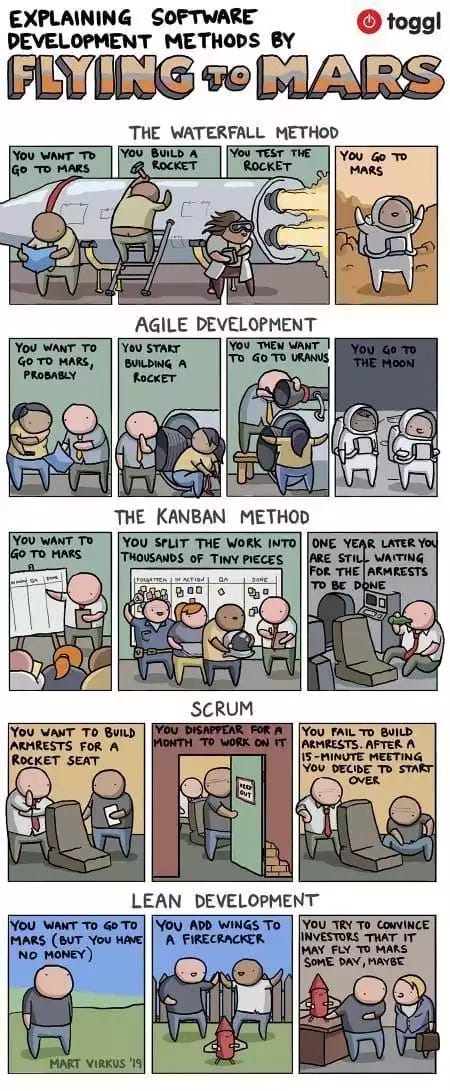
Let’s hope the Artemis mission used the Waterfall method.
In any case… coding was done to a set of requirements and had a solid framework… so what makes Girls code differently to Boys?
I think it comes back to how we are coded as children. I don’t know how girls are coded as for the most part I didn’t play with girls growing up. There’s a reason that awful expression Old Boy’s Club is used - its because some boys don’t grow up to be men they are just old boys and many of the boys I knew growing up had rules about keeping girls out… which is odd considering how much they were interested in girls later on.
What I do see on Substack and which I think Code like a Girl encourages is less solo hero adventures and more collaboration.
Lately I’ve noticed on my feed here lots of collaborative articles and interactions with women and not many by men. The same occurs on LinkedIn.
Here’s some info from Google AI:
“A study on cooperative behavior found that female players have a higher probability of between 11 and 23 percentage points to cooperate compared to male players, whose behavior was more "all or nothing".
Teams comprising women or having higher gender diversity have been found to perform better, with one study showing teams with two women producing work 17% better than teams of two men.”
Naturally I wanted to check some sources for this and the first I read was some medical research that basically said context is everything and in some instances men cooperate better together than women
The font of all knowledge has to be Reddit and the coincidentally named Women in Tech subreddit had someone say:
“Women aren't naturally more collaborative than men, but we are expected to perform much of the same emotional labor (for free, I might add) that we would at home. This ends up looking like "being collaborative" in office settings.”
Hmm… I do know that I preferred working with women on high stress/high cost projects as they were willing to work as a team and to often the men wanted to be seen as heroes and we didn’t have the time or space to deal with ego when millions of dollars and stressed clients were on the line.
So what about you though…
Are you seeing more collaboration amongst women writers than you are with men writers… I think that is supposed to read male writers but seeing as we don’t write womale writers I settled for men writers… sorry if I have derailed your answer please return to the beginning of this sentence.
I wonder if Code like a Boy would ever create anything more than competition… do men write in a solo way… I know we all write for an audience but are men collaborative in writing or do they prefer to stand out on their own?
It makes me think about my own art endeavours. Of which here is an update on the latest painting I’m working on

It’s still in the blocking in stage for most of it but you can get a sense of where it is heading - her dress is a complicated puzzle that I’ve just begun but I’ll probably work on his arm next so that I have the tonal values (the lights and darks) sorted before I work on the dress around his hand.
Art is often a solitary endeavour, unless you’re in a band and even then they can end up feeling lonely and go their own ways.
I wonder if I am following the code of the boy - where we are trained from a young age that play is a problem to solve.
Lots of women are artists as well so maybe they played with meccano as well… maybe we are all coded from a young age that life is a series of puzzles and its bad manners to toss the board upside down if you are losing.
I am impressed though with the level of collaboration and encouragement I see happening amongst the women writers. I suspect the real code that Code like a Girl sponsors is - its better to be a part of something than apart from something.
Wishing you all good reading this week and many happy collaborations to those who are becoming part of something bigger than their own world.
David, this is such a thoughtful piece. As always, I appreciate the level of reflection you bring to your writing.
I wanted to pick up on your point about the name Code Like a Girl. I can see why it might feel a bit unusual at first glance, but that choice was very intentional.
In 2014, Always created an ad where they asked men, women, and boys to run like a girl, fight like a girl, and throw like a girl. When they modeled the actions, they did them in a weak, silly, ineffective way.
Then they asked girls to run like a girl, fight like a girl, and throw like a girl. They did it with gusto, with speed, with heart, and it didn't look weak or silly at all.
Then the producers showed the Women, Men, and boys what the girls had actually done when asked to run like a girl, fight like a girl, and throw like a girl and asked them to reflect on it. On why they did that and if what the girls actually did changed their perspective. It did.
https://beloved-brands.com/always-like-a-girl/
The whole idea was reclaiming this idea that doing things "Like a Girl." Shouldn't be seen as weak, sad, pathetic, or less than. It should be seen as doing it well. We should be proud to do things like a girl.
At the same time, in the 2014 Olympics in Sochi, the Canadian Women's hockey team won Gold.
Marie-Philip Poulin scored with 55 seconds remaining in regulation to force overtime after Canada had trailed 2-0. Then Haley Wickenheiser drew a penalty on American Hilary Knight during her breakaway in overtime, which led to the power-play situation. Poulin scored the winning goal on the power play to complete one of the most significant comebacks in Olympic history. It was a beautiful victory.
For weeks after this game, there were social media reports everywhere that girls and boys in Canada were playing street hockey, narrating this over and over. In the same way they did with their Male Hockey heros like Sidney Crosby. Boys were overheard on the street saying, "She Shoots, She scores!!!" Or "Wickenheiser to Poulin, she shoots, she scores!!!"
You have to understand that for many years, it has been an extreme insult to be told you play hockey like a girl. Here we were celebrating it. It was amazing.
So it was on the backdrop of this that, in the spring of 2015, I went to an event for Grade 9 girls called Think About Math. Held at the University of Waterloo, they brought in Women who previously earned math degrees from the university and had them speak with the girls about what they could do with a math degree. I didn't want to be some boring old lady telling them about my job. I wanted to inspire them. So I created a sticker with a girl on it that said "Code Like A Girl."
It also sparked something in me. This idea that women were not really accepted in tech. That there were so few of us. That we were often told we weren't technical enough. That to code like a girl was an insult, and I wanted to take it back. I wanted women to be seen as equals when it came to coding, that we belonged here. I wanted to change the narrative that Code Like A Girl was a bad thing.
In January 2016, when I needed a name for a Women in Tech publication that I was starting, it was right there in front of me.
Code Like a Girl.
The whole goal, especially in the early days, was to change perceptions of women in tech, get more girls interested in careers in tech, and help allies know how to support us.
Over the years, it has moved more into supporting women in tech by amplifying their voices, creating a community around them, and offering tips to allies on how they can help.
We still sometimes touch on Girls in STEM, but not as much as we used to.
So yes, it is weird that I run a publication that says Code Like a Girl, targeted to women. But we all still have a little girl inside us that was told we weren't good enough, and this is us reclaiming that.
Thanks for your continued support, David, and your thoughtful story. I hope you are having a wonderful easter weekend.
I never thought about board games that way.
Gladiatorial, yeah, that’s exactly right. Monopoly with my brother always ended in someone flipping the board. Guess who flipped the board? lol
To actually answer - yes, I see more collaboration among women writers on Substack and LinkedIn. But I also wonder if that’s partly because women have had to build those networks intentionally, since the old boys’ club wasn’t going to invite us.